I also think I need to re-think my song “Daft Jamie” from the title on down.
My character Jamie is a little boy with some mental disabilities who always wanted to explore the stars. He sings a song to himself that no one else can understand about this yearning. His father, though, who has always shared a special bond with his boy, gets it. When Jamie’s brothers and sisters are abducted by a sort of alien Pied Piper, his father sacrifices his own life to ensure that James has a place on the same starship–so that he won’t be left behind.
Jamie is named after the penultimate victim of the Burke and Hare murders, James Wilson, who was locally known as “Daft Jamie.” I did this because when I read about him, and the awful way he died, I just wanted him to _live_. And since I was writing these Distant Star Ballads, I thought he could live there. His story sort of collided with the Pied Piper story and my song “Daft Jamie” came out of it.
It’s a cruel song, about a bad bad bargain. And a little boy getting his heart’s desire at the end comes at a terrible cost, and may not be such a great thing anyway…
But I’m not sure, ultimately, the cruelty of Jamie’s nickname—which says something about humanity and human history—is worth the cost of singing it.
Need to tweak a lot of lyrics and think the whole thing through again.
There’s a video of the original here, on Facebook, from 5 years ago. It’s changed even since then, minutely. I will have to keep chewing on the idea of nuance, complexity, point of view, necessity, what serves the story, and the world.
When did our “Ballads from a Distant Star” project start? I’ve been chewing on this all morning, every since I started singing in my kitchen over morning tea.
Well. It all started back in the oughts, I think. The mid-oughts, that is. I didn’t meet most of my “goblin girls” (as I like to call them) till ’04 or ’05 at least, maybe a little later.
(Aside: I love saying “oughts.” I love this sense of a turning century, and having been a part of it. Maybe that’s why I set my Dark Breakers stuff at a sort of alternate turn of the last century. Scary parallels, but also glorious.
There was a period of time wherein all of us mid-twenty-something fantasy-writing, poetry-scribbling, performance-oriented folk, having just found each other at writing conventions, and perfectly ecstatic with our new friendships, started burning mixed CDs for each other.
This was, of course, back in the days we still did that.
(Aside: I have just discovered Spotify playlists in the last month, so. Now I know how to do that at least.)
Thus, from those days, I still have a whole playlist of music called “Goblin Girls,” which is some 13 hours, 4 minutes long: an eclectic range of songs straight from the minds of wonderful people, many of whom, over the course of the next decade and change, became my dearest darlings.
Part of that, but also separate from that, I began to learn that Caitlyn Paxson seemed to know EVERY BALLAD EVER.
And I? I only had a smattering, mostly as re-arranged by Loreena McKennitt.
I burned to know more.
So I said to her, “O GREAT CAITLYN! TEACH ME YOUR BALLADIC WAYS!” or something to that effect.
And Caitlyn responded by making me another playlist–this one only 6 hours, 58 minutes long–of all her favorite ballads.
Well! That sparked my imagination no end.
As I learned these ballads, and as we geeked out together over them, Caitlyn and I began writing to each other, talking about setting stories in a shared “Ballad” world. We even began–and got a good ways into–a few stories and novellas in said world.
Our big “what if” was this:
What if a bunch of miners from somewhere, say West Virginia, were body-snatched by aliens and made to mine on a distant planet?
The mining company–Candletown Company, I called it, and have used that company in various fictions, poems, and songs, though not all of them are the same Candletown Company on the same world–was, of course, complicit in this body-snatching event. The coal bosses agreed to trade their miners and their families (unbeknownst to the kidnappees of course, and without their consent) for alien technology that launched them into a space age rather earlier than our own history has it.
(Does this sound vaguely Desdemona-ish to you? THERE ARE SOME IDEAS THAT KEEP COMING BACK! I think about them and mull them and brood about them and work them in different ways. Why is that, I wonder? Why am I constantly writing about rich people who trade the lives of poor people in order to get richer, I wonder???)
But back to the body-snatching aliens . . .
They, being a conquistador-like creature, planned to send our Earth miners to a planet not their own. A planet that was, in fact, anathema to their physical beings. But these aliens wanted the resources on this planet, and so they sent humans there, who, after some body-modifications, could withstand and integrate with the atmosphere.
On the way to this planet, the humans aboard the prison ship mutiny. They take over the ship, but they can’t fly it, and it crashes onto the same planet where the original course had been set.
The aliens who kidnapped them do not survive the landing, and the humans are stranded.
The stories that Caitlyn and I started writing took place many years after these events.
We had the idea that they were being told from the point of a view of an ethnomusicologist space pirate who found evidence of the body-snatching in some old archives of a long-defunct mining company and went in search of these lost miners in space. She wanted, you see, to hear what sort of music had been preserved from that kind of trauma and isolation, and to study how it might have changed. So she’s a part of the narrative but also distant from it, an observer. She doesn’t want to corrupt this new music.
The distant planet itself, it turned out, was sentient in a way. It could not communicate in language with the humans who had crashed upon it, but it could respond to their music.
In essence, the ballads that the miners brought with them shaped the planet’s response to them. It tried to become the stories and songs they were telling it, in order to welcome them. But of course, ballads are often tragic.
Generations later, the planet has become a sort of living ballad that these miners’ descendants are all sort of trapped in/adapted to. Not only the miners, but the planet itself, have become hybrids, integrating with each other. Amal El-Mohtar, when she joined the project later, was very interested in all of us teasing out the differences between integration and assimilation–which we all found very exciting!
PHEW! So that’s the origin story for “Ballads from a Distant Star.” I still love the idea.
But what came out of this slapdash, happy, haphazard worldbuilding, ultimately, was not stories and novellas–as we had intended–but a body of music!
We ended up writing the ballads that our ethnomusicologist space pirate was interested in–ballads about the abduction, about the journey across the stars, and the landing. And about what happened after.
I also wrote a story-poem, which Mike Allen published over at Mythic Delirium, called: Voyage to a Distant Star.
We’ve sung our ballads at various cons and mini-tours, performing under the umbrella of the Banjo Apocalypse Crinoline Troubadours. We also used that umbrella to perform various unrelated prose and poetry pieces as well. The group of us who did this kept changing and mutating, but the core of us were Caitlyn, Amal, myself, and Patty Templeton.
Now, after many years, we have enough material for an album. With Caityn’s permission, I’ll be using three of her songs:
“Rare Annie”–about a miner’s wife who learns her husband has died in a collapse, but won’t let them bury him, but places him in the heart of a spaceship she is building of “vine and twine and bone,” which she has called by the name “Fetch” and insists will take them both to their home planet, as he always promised her:
“Annie’s got a dead ship Fetch Of vine and twine and bone Annie’s gonna lure and catch Her Willie-o, her Willie-o She’s gonna bind her Willie-o When Willie, he comes home . . . “
“True Thomas”–which is a retelling of Thomas the Rhymer, only instead of encountering the Faerie Queen, he is encountering this alien species;
“Tell me true, my Tommy, You’ve been gone from me so long What lands have you been wandering With your banjo and your song?
“I’ll tell you true, my darling, It’s amongst the stars I bide. No earthly lands have touched my feet Since the night I left your side . . . “
And “Strange Babes”–about a woman who takes an alien creature for her lover but cannot abide what happens after, and who is haunted by her actions forevermore.
“She fled the tunnels, fled the mines Down and down and down All to leave those strange babes’ songs behind Down in the deep deep ground
“When she reached the surface fair Down and down and down She found their songs were waiting there From down in the deep deep ground . . .”
I love these songs so much! I’m delighted to revisit them, and to collaborate with my musician brother Jeremy Cooney and our friend Stefan Dollak. They both played with me on my last Brimstone Rhine album, Corbeau Blanc, Corbeau Noir. Between them, Remi and Stefan play, like, one billion instruments. A lot of Caitlyn’s songs are for the banjo, which, thankfully, Stefan can play. Well, he plays his “banjolele”–close enough, as they say, for folk music.
Some other time, I’ll tell you about Amal El-Mohtar’s Embersong, another Distant Star ballad, though you can read about it yourself on her blog, and watch the video/hear the song. That’s Caitlyn on the harp. She arranged it all, beautifully.
I’ve been thinking about these songs a lot, since I’ll be singing some of them next week Friday at WorldCon, and I’ve been rehearsing.
This morning, as I mentioned earlier, I was singing Caitlyn’s “Rare Anne” and “Strange Babes” in my kitchen at the top of my lungs.
But singing these songs only whets my desire to record the album entire. It was ever thus.
And once that is done, perhaps, I will write some of those stories I started . . . at last.
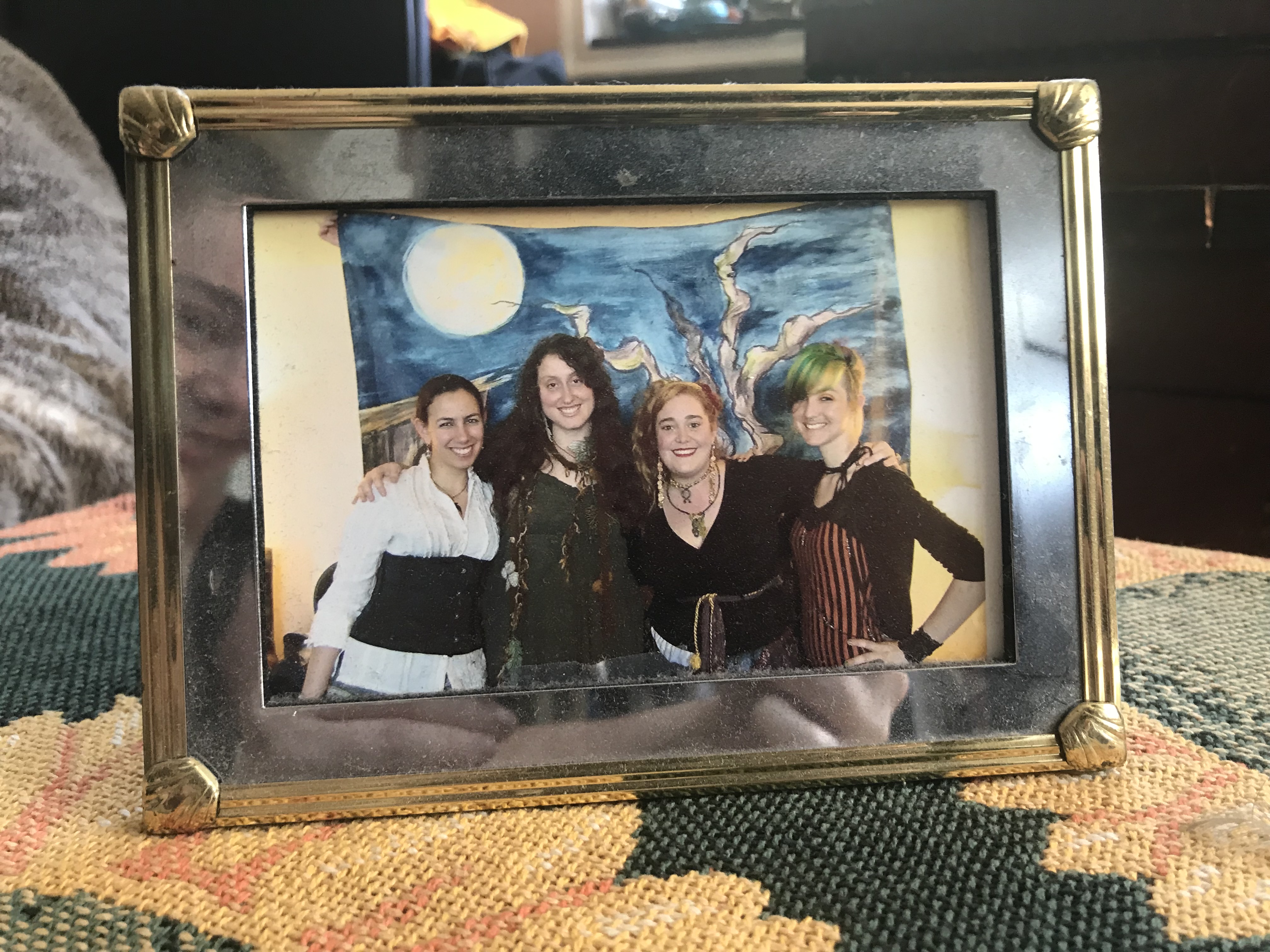
Depicted, the Banjo Apocalypse Crinoline Troubadours: Amal El-Mohtar, Caitlyn Paxson, myself, and Patty Templeton–who will be designing linocuts for the album cover and the internal art for the digital book of lyrics and poems.
Finally, this morning, I did what I’ve been meaning to do LO THESE MANY MOONS.
I re-wrote “Jenny’s Song for John.” Somehow that’s its title now, though once upon a time, I just called it “Song for Jenny and John,” but I think it’s really Jenny’s song, so that’s probably what happened.
It has three distinct melodic verses, and in the rough first draft–which somehow never advanced past that stage, even though I’ve performed it in public multiple times–those verses occur haphazardly, and there’s no predicting when I’m going to place the next one.
So I rewrote the lyric in order that the verses go ABCB, structurally. And each cluster of ABCB stanzas is one verse. 4 stanzas per “verse,” and the song is 4 verses long.
That doesn’t sound very long, except when you realize it’s really 16 stanzas, so . . . BALLAD TIME!
I like that it’s longer, because it’s the opening song to the new concept album (forthcoming), and it tells a fuller story about what happens to the body-snatched miners who find themselves on a silver ship sailing the stars.
I’ll be debuting the new version of this song at my a cappella concert at Irish WorldCon, this Friday in Dublin at 13:00 (or 1 PM). It’s a short concert, but I hope to give everyone a taste of the forthcoming Ballads from a Distant Star.
I’m planning on singing “Daft Jamie,” “Sisters Lionheart,” and “Strange Babes” (this last by Caitlyn Paxson, the others by me) as well. But we’ll see what we have time for!
In the meantime, for those of you who are interested, have some lyrics! And keep an eye out here for the CROWDFUNDING CAMPAIGN, coming soon to a social media platform near you. Amal El-Mohtar, Caitlyn Paxson, and I have been developing songs for Ballads from a Distant Star for many years now, and I am excited to be bringing it to your ears at last–in a more lasting form!
Jenny’s Song for John
1. My love, his name is John Fitzgibbon Strong as oak and tall as yew Soft as pine and so sweet-smelling Ne’er was any man so true
Down he went with lamp and hammer Down into the blackest seam Where the rock burns bright as diamond Daylight’s but a dead man’s dream
Oh, they came in flame and thunder Oh, they came in ice and steel Came and snatched my John Fitzgibbon Bound him to a silver wheel
Where’d you go, my John Fitzgibbon? Johnny, would you leave me so? John, I’m cryin’, John, I’m dyin’ John, you’re gone and I’m brought low
2. My love he shouted loud as lightning Broke his chain and smote his foe Ran those halls of pearl and sapphire Where no mortal man may go
“Turn this ship, O turn it back now!” Shouted John, so bold and brash “Bring me to my love, my Jenny Lest I burn this ship to ash!”
Oh, they laughed like flame and thunder Oh, they laughed like steel and ice “John,” said they, “she must be dandy “You’ll not need to ask us twice.”
Down they drove their iron casket Down through darkness wide and deep Found me stretched across my bower Sore with grief and fast asleep
3. My love, he spake to me so softly “Jenny, rise, we must away If we do not go this instant We’ll not live to see the day.”
“John,” said I, “I love you dearly Johnny, whither thou wouldst trod There will I put down my footprints This I swear by Holy God.”
Oh, I wept like flood and river Oh, I wept like sea and rain Wept and left my bower forsaken Ne’er to there return again
Down we flew, in night and starlight Down into abyssal gleam Down into that vast forever Where no mortal maid has been
4. For the love I bore for John Fitzgibbon I gave up the world I’d known Sought those distant stars forbidden That I could not call my own
Far we flew, and rough we landed Split the sky and chipped the hull Cracked our ship of ice and silver Spilled out from our prison walls
Oh, they wept like flame and thunder Oh, they wept like molten ore Even Johnny couldn’t save them And their proud race is no more
Down we delve with lamp and hammer Bearing children on the way As we dig, we sing forever: “We’ll return to Earth one day.”
On my way to our GOBLIN MASQUERADE at The Savoy Bookshop and Cafe in Westerly, Rhode Island at 6 PM.
Even if you’re far away with no teleportation device near at hand—throw on a costume, a mask, and join our virtual masquerade!
Celebrate Desdemona and the Deep with me! Post pics! Tag me! You’re welcome to join in!
If you want koboldish playlists, goblin recipes, and ideas for a night of dress up and books (very like how I’ll be be spending my night) (yes, drenched in rhinestones, yes), please take a nose-dive into this HOW TO I made for you!
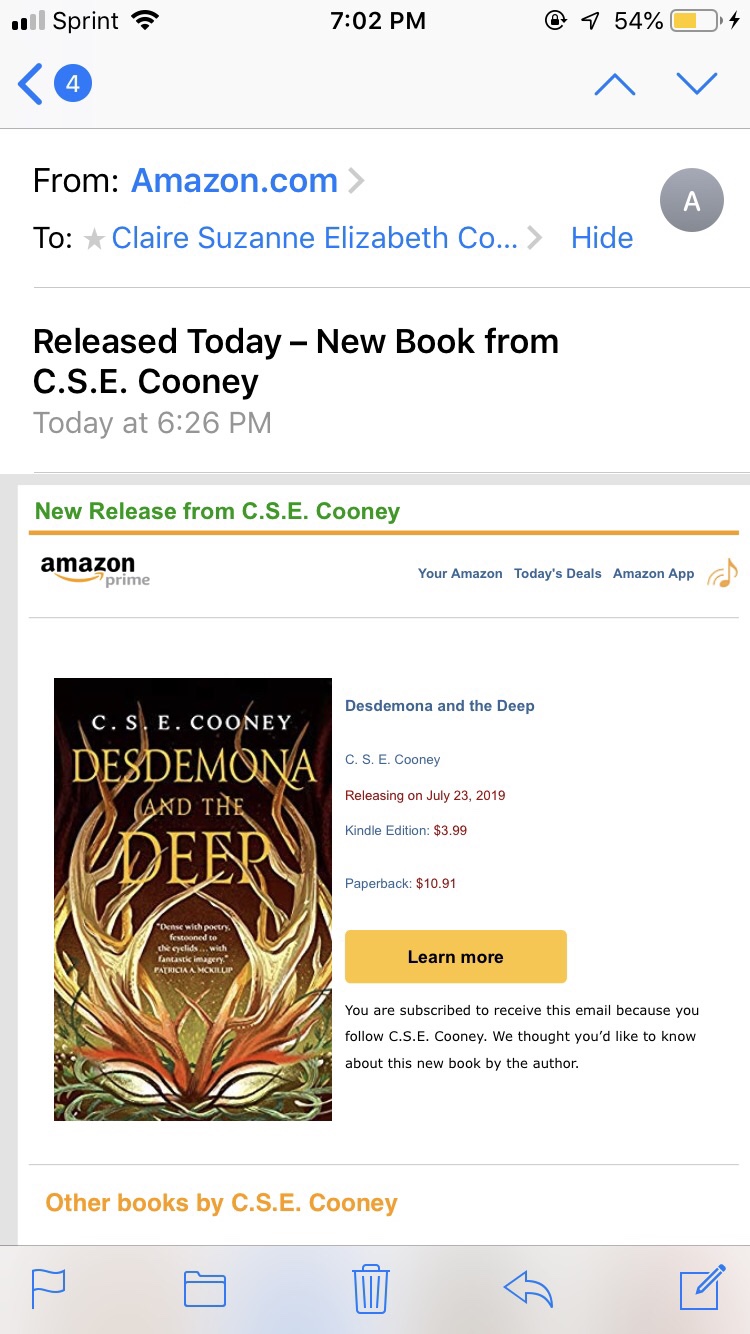
Desdemona and the Deep–the AUDIOBOOK!!!–is now available. Narrated (with very great pleasure, and very DROLLY) by yours truly, C. S. E. Cooney: the Author herself.
Savoy Bookshop and Café invites you to join us for a masquerade and book launch in celebration of award-winning author C.S.E. Cooney’s new novella Desdemona and the Deep.
Re: Goblin Masquerade: Costumes are highly encouraged but not mandatory. Come dressed up in “goblinpunk” or “faerie finery.” Think of movies like Labyrinth, Legend, Willow, Lord of the Rings, and Hellboy 2! Paint your face, put on a mask, break out that old set of fake fangs!
There will be live music, a reading, and giveaways! Snacks and wine will be provided!
When: Saturday, July 27, 2019 What Time: 6:00 PM — 8:00 PM Where: Savoy Bookshop & Cafe 10 Canal St., Westerly, R.I. 02891 United States
ASTORIA BOOKSHOP
Join award-winning fantasy author C. S. E. Cooney at Astoria Bookshop for the NYC launch of her latest book, Desdemona and The Deep.
There will be a reading, signing, and giveaways! Snacks and wine will be provided!
When: Tuesday, August 6, 2019 What Time: 7:00 PM–8:00 PM Where: The Astoria Bookshop 31-29 31st Street, Astoria, NY 11106 United States
ABOUT THE BOOK
In Desdemona and the Deep, the spoiled daughter of a rich mining family must retrieve the tithe of men her father promised to the world below. On the surface, her world is rife with industrial pollution that ruins the health of poor factory workers while the idle rich indulge themselves in unheard-of luxury. Below are goblins, mysterious kingdoms, and an entirely different hierarchy.
17 Aug 2019, Saturday 13:00 – 13:50, Wicklow Room-1 (CCD)
Narrative, mechanics, and visuals are the core of every game. How can we use these building blocks to create a more inclusive gaming experience for everyone?
Whether they are protectors or dangerous beasts to be feared, children’s literature is filled with creatures of all kinds: big creatures, small creatures, thin creatures, tall creatures. From Pantalaimon to the Grinch, the Dementors, Winnie-the-Pooh, and more, we will take a special look at the fantastical literary creatures of children’s fiction.
Narrative and Storytelling for Games: Panel
17 Aug 2019, Saturday 19:00 – 19:50, Liffey Hall-2 (CCD)
The manner in which games create narratives has led to, arguably, some of the most compelling storytelling presented in any form. How does this form of narrative differ from more established forms in literature? What unique opportunities and constraints does this medium present to writers and narrative designers, as well as players?
C. S. E. COONEY
Concert: Brimstone Rhime ( C. S. E. Cooney)
16 Aug 2019, Friday 13:00 – 13:20, WH2 – Performance space (Point Square Dublin)
Brimstone Rhine is the musical alter-ego of fantasy writer C. S. E. Cooney. She writes songs of myths and monsters, star-journeys, weird birds, and women who eat people.
Speculative poetry encompasses themes from science fiction, fantasy, and horror as well as all of the subgenres in between. Dublin 2019 presents a special showcase of poets who have come together to perform a selection of speculative poetry and to share the magic of this exciting medium. This reading will feature new and classic works from speculative poetry’s mainstays, rising starts, and trend-setters.
I find myself making this announcement a lot, but it’s worth it, and the internet is a vasty place, so here we go again:
Desdemona & the Deep is actually a standalone novella. Tor.com is marketing it as such.
The first two stories set in the Dark Breakers world I self-published. Now, they did go on to have a life beyond my little Amazon ebook experiment in reprints–to my great joy and surprise! But the ebooks are out of print now, by my choice, though you can still find the reprints in one of Rich Horton’s Year’s Best anthos, and in one of Lightspeed Magazine‘s ebooks.
This is obviously confusing to people. I apologizefor the confusion—it’s a goblin market, after all!
Before Desdemona was written, I had originally conceived it as third in a series, but that was when I was still planning on one day self-publishing it. After I wrote it, it was obvious thatDesdemona was a different beast entirely (not a romance, for one) (twice as long as either, foranother), and had a chance at something bigger.
When that became evident, I spent a lot of time and effort (and had both my agent and my editor, who hadn’t read the other stories, look at it closely) editing it to be a stand-alone novella.
Chronologically, the events in Desdemona do occur after other events in other stories. But those events weren’t her events. Her character’s arc is contained to this novella. She’s a very minor character in the other stories.
So again, Desdemona was indeed written to be read as a standalone book. Eventually, I’ll put the other two stories back in print, after I’ve fixed some of my earlier errors. But I don’t think they’re necessary for you to enjoy Desdemona as is.
And I really don’t want Desdemona, as a new book, to languish because readers think they must read the first two stories before they take a chance on her.
You’ll be meeting the Umber Farklewhit (AKA “Ambassador Farklewhit”) (AKA “Nanny”) (AKA I’M NOT TELLING YOU WHAT ELSE) roundabout Chapter 7 of Desdemona and the Deep.
He’s one of my favorites.
My husband, Carlos Hernandez, part writer, part professor, part game-designer, and pretty much 78% Farklewhit, took a liking to the character.
I CAN’T THINK WHY.
Anyway, for our Goblin Masquerade launch party this coming Saturday at The Savoy in Westerly (details here. Yes, you’re invited), Carlos decided to COS-PLAY as Farklewhit! I couldn’t be happier!
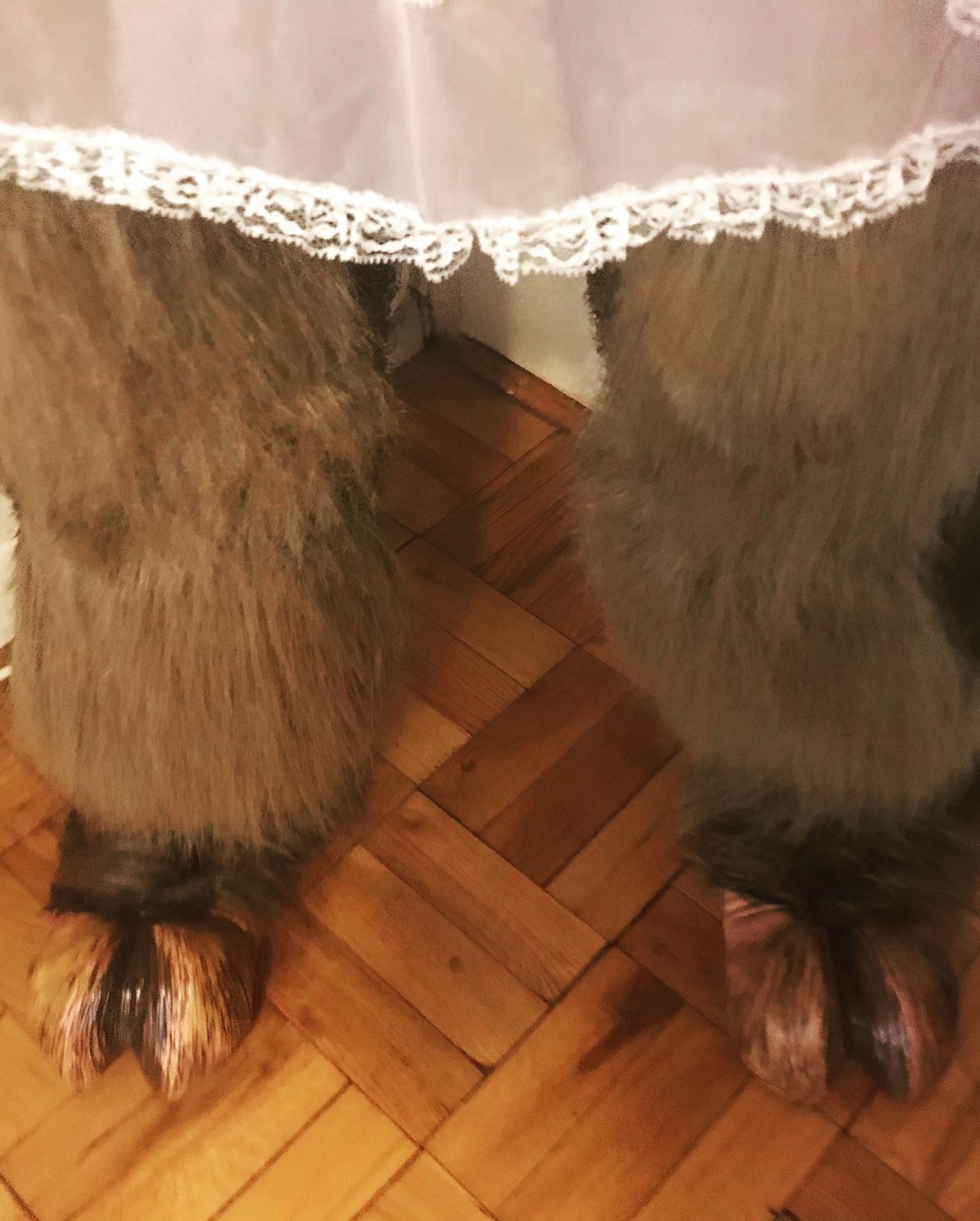
You get a sneak-peek at his costume here. And remember: if you can’t make the masquerade but still wish to dress up and join us, we’re having a VIRTUAL masquerade! (EXPLICIT INSTRUCTIONS HERE!)
So anyone who wants to can dress up, take pictures of themselves, and hashtag away on Facebook, Twitter, and Instagram. Or wherever!
I’m so interested to see what sort of costume you come up with.
In the meantime, may I present you, goblin ambassador to Erl-Lord Kalos Kantzaros, King of the Koboldkin, the UMBER FARKLEWHIT!
Today is the day my novella Desdemona and the Deep comes into the world at large. And I’ve been doing a lot of posting, tweeting, singing, dancing, thanking, and it’s all very joyful.
But now I want to talk about the dark start of Desdemona, in 2016.
I began the novella in November of that year. Everything felt just a little pointless in November of 2016. And, I have to admit, most of 2017 too. All of it, really. Art, especially.
Or, no, not everyone’s art. Mine particularly. It seemed so singularly frivolous, useless. Why finish anything? The point of 2017, surely, was to march in protests, donate to the ACLU, to RAICES, sign petitions, call representatives.
And I did some of that. Some, but not enough. Mostly–though it was a slog–I did what I always did. I wrote.
But I told myself, “The only way you can make this count, Cooney, the only way you won’t be wasting your time, is if you do something concrete with the art when you’re done. Something that supports the real work going on out there while you sit on your butt and write fantasy.”
Now, that was despair talking. I truly believe (on my better days) (and my husband Carlos reminds me) that art is work, and that work is part of the long conversation, part of changing minds, hearts, changing culture. The work we do as artists isn’t useless, even if it sometimes feels that way.
But knowing that wasn’t enough to finish Desdemona. I needed something that translated thought more directly into action. I needed a vow.
So I said to myself, “If and when you ever publish this honking beastie of a novella, Cooney, you will donate the proceeds to the ACLU! It will be your tithe.”
As Desdemona learns in the eponymous novella, a tithe is a tenth. In the spirit of any good goblin bargain, I will tithe a portion of my income every month at full moon (in the Desdemona mythos, I call it the “Gentry Moon”) to charity. And I will be reminded, every month at full moon, what I owe the world for this novella. The price others paid so that I could write it.
These are the charities I’ve chosen. I’ve gone through and found the full moons of each month, and I’ll put them into my calendar with multiple alerts, so that I won’t fail in my vow.
And I am writing this all here today, to hold myself accountable.